Physics Day 20: I survived another year of teaching position graphs

It’s the end of the quarter, and I admittedly did not do a very good job of preparing myself mentally for what was to come today. I knew it was going to be a short period (65 minutes instead of our usual 75 minutes). It wasn’t until I was chatting with another teacher did I realize it was…position graph day. This meant that we were going to need an insane amount of post-its. I’m grateful that the team ordered the post-its beforehand. I just needed to cut them so that so that they would fit on our whiteboards.

With Block 5, I cancelled the Quick Quiz first to save 10 minutes. First, we had the students draw the position line, but with the positive arrow facing left. Then we had them do the motion maps with delta-t at 2s, 1s, and 0.5s. THEN we did the 90-degree rotation of the graph. I’m proud to say that the students all did it, with minimal post-its falling off. I think it went much easier because they all had the same data. So when the students looked around and saw that their boards didn’t look like the others, they received immediate feedback that theirs wasn’t going well.

Block 5 students did a fairly exceptional job of following directions and making sure their boards look great.

The slopes came out pretty well. The discussion towards what does the slope represent was perfect. The students were able to hit it out of the park. It definitely helped that they also covered slope-intercept form in Algebra last week. I think this year, the students were able to identify what y, m, x, and b all represent on a position graph in the quickest ever.

I’m not sure if I prefaced it to the students that I despise post-it day. They were all on excellent behavior—which resulted in a class full of students on task and asking genuine questions to gain a better understanding.

After teaching today, I ran into Mrs. F and we both agreed this is one of the hardest teaching days. Now, we’re thinking of getting shirts made for us to wear.
Day 15: Chemistry and Algebra

Looks like this week’s theme is: ALGEBRA

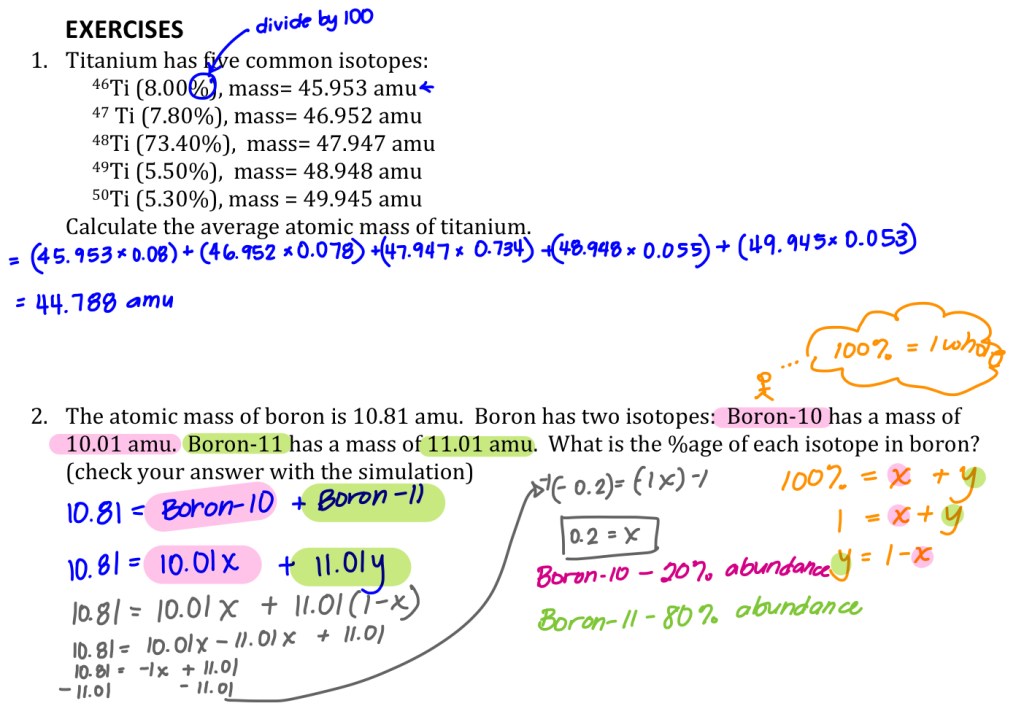
We were working on finding the average atomic mass of elements’ isotopes. This involved percentages, solving for one unknown…and solving for two unknowns. Most students were comfortable with percentages and solving for one unknown. Once we got to solving for two unknowns, we kind of gave up. There were a couple of students who tried really hard and looked at the textbook copy in the classroom, searched “how to solve two unknowns”, or used AI tools to solve the problem.

Challenge 1: How to deal with percentages. Students did not know that dealing with percentages meant that 8% = 0.08 = 8/100. Once we got over this, some continued on with the journey of solving for abundance of isotopes in a sample. Another one was 100% = 1 whole. We were having trouble understanding 100% of the pie is equal to 1 pie.

Challenge 2: Finding the average. One of the problems gave the masses and abundance of 5 isotopes. Titanium-46 through Titanium-50. They were supposed to calculate the average atomic mass of titanium. Instead of dividing by 100, students were dividing by 5 because they couldn’t not differentiate between the number of different isotopes from the number of occurrences. I started calling the masses “test scores” and the percent abundance “students”…and then it became easier to understand what the class average was. As soon as I said average atomic mass, the analogy was no longer understood.

Challenge 3: Finding two unknowns. One of the problems gave the average atomic mass, but did not give the abundance percentages. Instead, students were to find the abundance percentage. Students did not have the confidence to find it. There were a couple who were able to go back to work as soon as I said substitution method or find out what y is equal to. The majority of the students were able to work it out and apply it to the next problem when I solved the first problem of its kind. A few were very much confused from the start to finish.

Once they solved for Boron-10’s percentage, very few were still asking how to find Boron-11. After giving two options, students forgot where 1 = x + y came from.

Overall, it was a very arithmetically taxing day, but I didn’t think it was difficult. I admitted to the students that when I sat down to make the answer key for this worksheet, I didn’t really want to because I was being lazy. But in the end, the actual algorithm and steps to completing it weren’t hard, I just didn’t want to. I’m hoping that motivated them to think of algebra as easy and not something I want to do as opposed to something that is hard and only for smart people.

Exit Ticket Retake

Consistent with the theme, the exit ticket had some challenges as well. It wasn’t really hard mathematically, protons = atomic number, protons + neutrons = mass number, protons + electrons = 0, etc. Conceptually, it was new and they really needed another practice. I would like to somehow have students whiteboard some problems so that they think through it together.

Day 14: Physics and Algebra

Today was Day 1 of 4 of the Frosh Retreat. For Block 5, I had 6 students present for class, and everyone else was rostered to be at the retreat. I don’t actually know if anyone was absent, but I expected them to be at the retreat. Block 6 – everyone was present. This 4-day retreat makes lesson planning difficult because it’s also at the end of the grading period. It’s not ideal that the retreat happens at this time. Perhaps, it would be better at the beginning of the next grading period as opposed to the end of the grading period.

Today’s goal was to have students practice calculating next-x, current-x, velocity, or delta-t given the others. Mrs. Freudenberg’s preference is to isolate the variable given x = x0 + (velocity * delta-t). I like to plug all the numbers in THEN isolate the variable. I will allow the students to choose a method they like better. I personally do not like the isolating the variable given the equation first. HOWEVER, Mrs. Freudenberg does teach AP Physics, so perhaps her method translates to making it easy once students reach AP Physics.

In the past, students found this day to be easy and the application of all that we’ve learned in Pyret and Physics. Today, we found out that the students found this to be the peak of their frustration (AS A GROUP). There were individuals who found this to be easy, but as a group, students expressed their frustration at not finding this easy at the first go.

I will need to make some videos this week to help the students understand this better.

Chem Day 11: Periodic Table continued

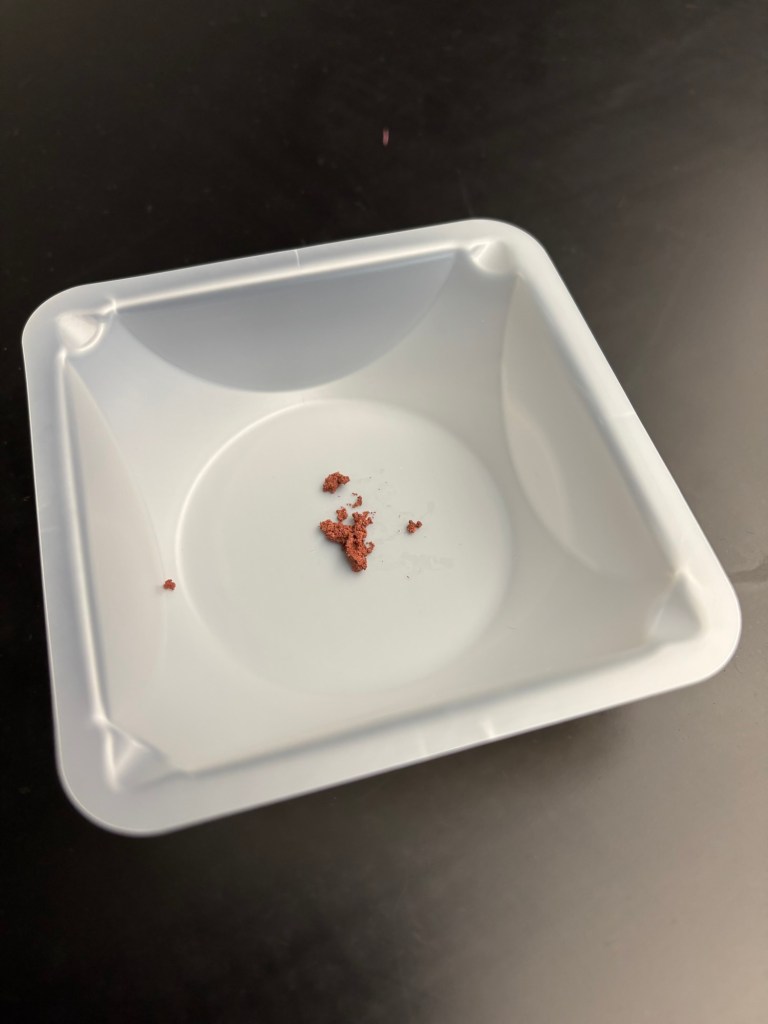
I had big plans for Day 11. We spent most of the class completing the Periodic Table instead. We had to take some time to review the Lesson 8: What Comes Around, Goes Around that was assigned for homework. Student feedback was that it was repetitive. I said that it was supposed to be repetitive. One of the students said she noticed that what we ended up with became what we start with for the next step. Though the students recognized that we began and ended with copper, I’m not really sure that they understood that matter was not created or destroyed (which was the whole focus of the lesson). In looking ahead, they were supposed to understand that Copper solid + Nitric acid was supposed to result in Nitrogen dioxide, copper nitrate, and water. I’m not sure where or how they were supposed to recall all of those chemical formulae.

After this, I went into teaching the periodic table. I’m not sure I agree with teaching the whole periodic table at once. Rather, I would have liked to take some time and go through each of the groups and learn through context. We found Periodic Table Lesson from Layers of Learning. We went through the main elements, annotated our periodic table, colored in the groups, and had students write down some pieces of information about each of the groups. The students seemed to like this activity, but I’m not sure they really knew what or why we were doing it. It’s taking 3-4 classes to learn that each Group has similar properties. One of the exit tickets would ask for an element similar to a named element, and they did not know to look within the same group for the correct answer.

The finished product of one of the students’ periodic tables.

Physics Day 10: Buggy Lab

The beginning of the velocity unit has always been a bit hairy. This is when the “true” modeling part of teaching comes out. I ask: “is the buggy moving?” In the past, it has become a controversial question and students leave the room wondering if it really is or isn’t. This year, the students were able to move on to prove whether or not it’s moving.

As part of the proof, students mark their receipt tape every time they hear a tick (which is a metronome playing at 30 bpm). In the past, I’ve let the metronome play until the lab is over. This year, we did each trial together. I asked students to pick their starting point and a marker color, and then mark their receipt tape. Then, I would stop it, ask them to recollect themselves, and we would start again. This happened for each of the trials. Most of the groups were able to keep up. A couple groups realized they were not doing what they were supposed to do and eventually caught up.

I asked the students to write down the exact position of their markings on their receipt tape. In my mind, all the group members would be working on this since multiple meter sticks and things were provided. What ended up happening for most groups is that one person was doing this part and the other two were socializing. This is the part that took the longest or had the most errors. Even though I added a couple photos of football players photographed either in their starting formation or mid-play on the 30 yard line, some groups still managed to record the distance traveled instead of position. Though, there were MUCH less groups than in the years prior. Another error I didn’t anticipate was calculating the average position at each tick. There were a couple groups that missed a step in calculating the average. For the most part, lots of groups had great data.

The discussion part didn’t happen very well since we had 5 or 10 minutes left in class. I think that we did enough so that they could complete the homework successfully.

Chem Day 10: The Copper Cycle

Whew! Our first actual lab in Chemistry, and this one was a heavy lab! It was the first time Gen Chem was going a lab of this sort in a while. I’m glad that the students were able to experience a “real” chemistry lab with “real” chemicals. Real is in quotes because all labs in chemistry are very much real and all deal with actual chemicals.

I know that there was a heavy discussion with what the purpose of this lab was. It falls as an introduction to the periodic table. I’m struggling to see how it would segue smoothly from The Copper Cycle into the Periodic Table. From what I gather, it should be about conservation of matter and an introduction to chemical reactions.

Our learning team leader, Ms. B, suggested that we have the materials for the lab pre-measured and ready to go. To prevent errors with all the clear, colorless liquids, we also handed the NaOH, HNO3, H2SO4, and water to the students when they reach that step. That seemed to work really well because students were forced to read through the directions again.

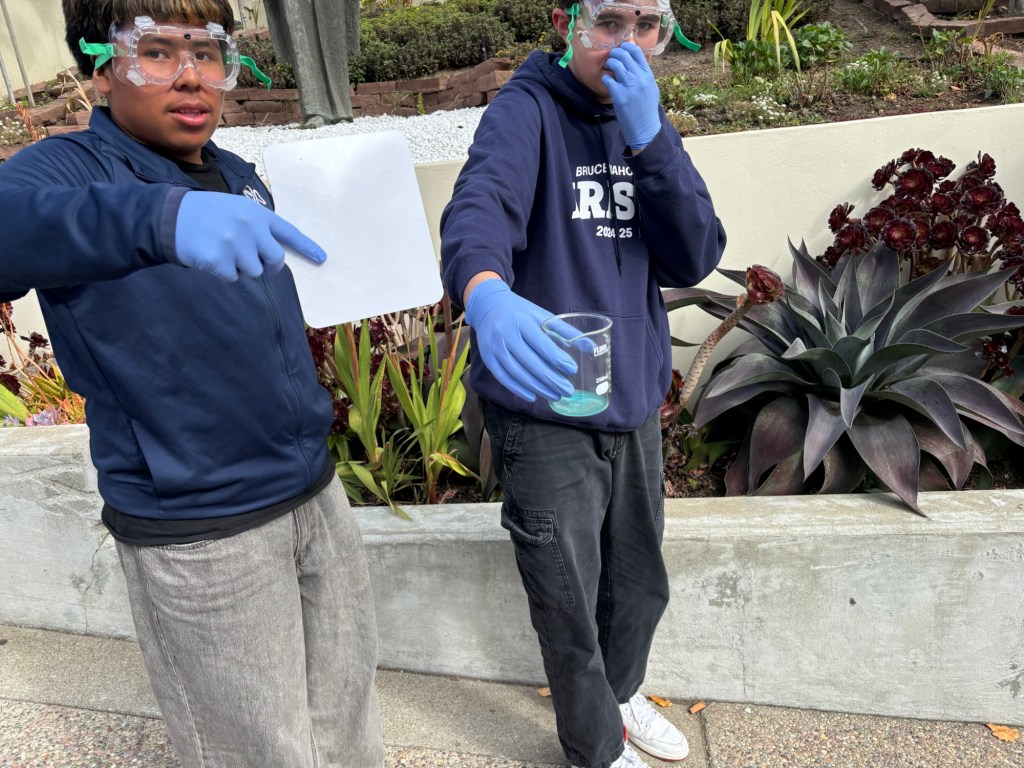
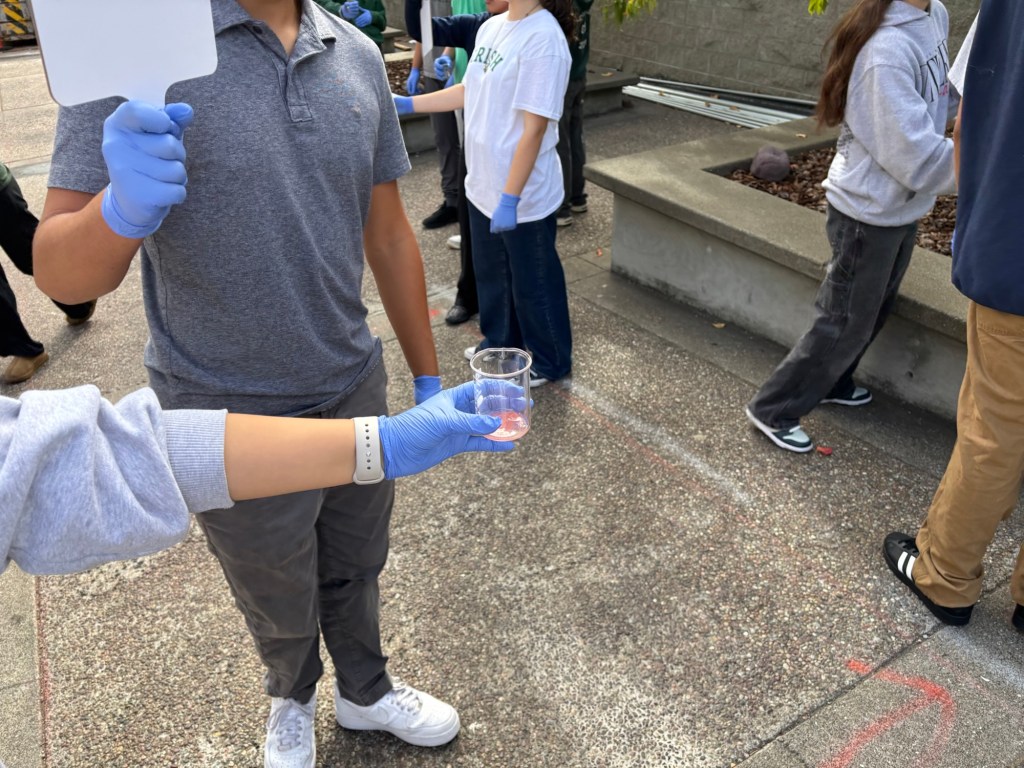
We asked students to add the nitric acid to the copper in the beaker outside. Last time, one of our colleagues did the lab, and we found it to be intense on the olfactory sense scale. So if had done it as written, inside the classroom, those toxic gases would have lingered longer than its welcome.

We were able to finish the lab. HOWEVER, it was this lab that I discovered that not all students know how to do the dishes. I witnessed one student squeeze 10 mL of soap into a 50 mL beaker. Another student left soapy glassware on the counter because they were clean. Next year, I may have to do washing glassware as one of the first activities we do early in the year.

Day 7: 2-Argument Functions

It has finally dawned on me why teaching Pyret felt both foreign and familiar. We are teaching the same material, but in a different order. At this point, we would have drawn some pictures using Pyret already. I absolutely understand why we skipped the playing with Pyret portion of the introduction. We simply don’t have a lot of face to face classroom time.

In addition to the change of order of the material, the Physics team has added function notation to the mathematical representation. Initially, it seemed silly and extraneous, but as we were reviewing the material, I see why.

For a problem like how many chocolate chips will I need if each brownie needs 6 chips? We know to set it up, it’d be like

1 brownie = 6 chips; 2 brownies = 12 chips…

If we put it through our function machine the rule would be

Input: number of brownies

Output: number of total chocolate chips needed

Rule: number of brownies * 6

Equation: C = 6 * b

Up to this point, students are very familiar with what we’re trying to do. It’s now writing it as a function notation where the wires get crossed.

C(b) = 6 * b

The sentence would be: the total number of chocolate chips (as a function of brownies) is six times the number of brownies. The idea that this equation can also be a rule for a real-life word problem went over some heads. It might be time that function notation be taught as part of writing equations. I think the students were getting stuck since parentheses always meant multiply. (And again—advocating for why PEMDAS is wrong). Having the students write out and SAY the sentence hopefully gets them into opening up their thinking that y can also be written has f(x).

I was sick when the 1-Argument Functions were taught. I was VERY proud of the students as they were able to whiteboard the problem for 2-Argument Functions. The students who had the confidence to just jump into a new and different problem loved to wonder how they can show two inputs in their function notation. Eventually, a group thought to do it by putting both variables with a comma to separate—like a list. Either we’re starting computer programming thinking in earlier grades, or it’s becoming more natural for the students to see their world in this way.

The added layer now is explaining each part of the Design Recipe. I wonder if I had equated it to a cookbook recipe if there would be some translation—hence a smoother transition. Or would that confuse them more?

Class 5: Density & Balloons on a Friday

To teach density in alignment with modeling instruction, I would have had students find a material’s density by measuring various mass and volumes. The density labs generally have students identify the unknown substances by comparing calculated density to known values. While what I envision would have taken longer, it would have allowed students to truly have a more innate understanding of Density. Today, we lectured that density is the amount of mass per unit volume of a substance.

Today, students calculated the densities of the items from the previous lab that was essentially practicing how to measure mass and volume. They measured the mass and volume for two cubes of uknown materials, two rods/cylinders of unknown metals, rock, and crayon. For the density lab, they calculated for the blocks and rods. Most of the students were not able to get the density for their rods to be close enough or similar to the substance’s known density. I was hoping that the value would at least be pretty close together. Some groups were successful in getting a number similar to each other. Some groups had VASTLY differing values. I revealed that the densities for the rods should have been similar. They were surprised.

I was convinced by the learning team that we could have the students design a lab AND cover CER for the rest of our class time. We did NOT have enough time. Last year, the students were able to do it all. We think it might have been because it was a Friday…Giving students something to play with (blown up balloons) after spending a while sitting might have been too much for a Friday. I think the way I would change this would be to include the density calculation in the Mass Communication Lab. THEN we would work on the CER and ask them what material they think their unknown substance is. It was pretty fun watching them measure the mass and volume of floating balloons.

Chemistry Day 3: Safety & Equipment Quiz + Matter

We had the General Chemistry students take a Safety & Equipment Quiz. They must pass it in order to participate in the labs. Students generally thought this was a fair deal. The quiz had a portion where they identified some lab equipment. We all switched it up for each of the blocks so that no one block got the same order of equipment as another block.

Some of the commonly mistaken ones were: crucible and cover, Erlenmeyer flask, graduated cylinder, and ring stand. I can understand why the ring stand was missed. When we set up the practical, I had the ring clamp attached to the ring stand. Not quite sure what the misconcepction is with the graduated cylinder. We had it on the Exit Ticket and it was one of the items that I thoroughly covered in the review. The other teachers and I have some disagreements whether or not to award full points for flask vs Erlenmeyer flask. I argue that we didn’t have a volumetric flask to compare–so not sure if we need to be picky about it. They felt strongly about being specific because this particular flask is common in the lab. I see both sides of it.

I really liked how we came up with the definition of matter. The students were to decide which items on the list were matter and which were not. They had to decide on items like: chair, air, mist from a perfume, joy, sun, thought, plasma, fire. For the common items, students found it really easy to decide if it was matter. Some of their definitions included “things you can feel.” When I argued that love can be felt, students had to review their definition and rules for what is matter. Eventually, they agreed that matter needs to take up space AND matter is made up of stuff. We gave them the definitions for mass and volume to give them language for their previous definitions.

One of the blocks decided that matter was a solid, liquid, gas, or plasma. When I asked what makes something a “solid”–they said it was something that was physical and cannot move. I asked if Ms. Medrano is a solid–they said yes. I asked if Ms. Medrano can move as I was walking around. Then they changed their definition to where particles were packed together and those are the ones that don’t move. I asked what the particles are…they said atoms. I asked what atoms were, and they were unable to define it. This means that they knew words and definitions, but didn’t really innately know them. This is where I think Modeling Instruction has its strength. The learning activities truly allows students to own their learning and their knowledge attaining.

This is the definition we ended up giving the students. Most of them said that Matter is anything that is made up of particles and takes up space.

Physics Day 3: Variables

Day 2 schedule had me flustered. When speaking with others, they felt the same way. So I started Day 3 by apologizing the students for allowing my frustration with the time constraints to fly. We spent the first part of class reviewing all the things we should have covered the previous class.

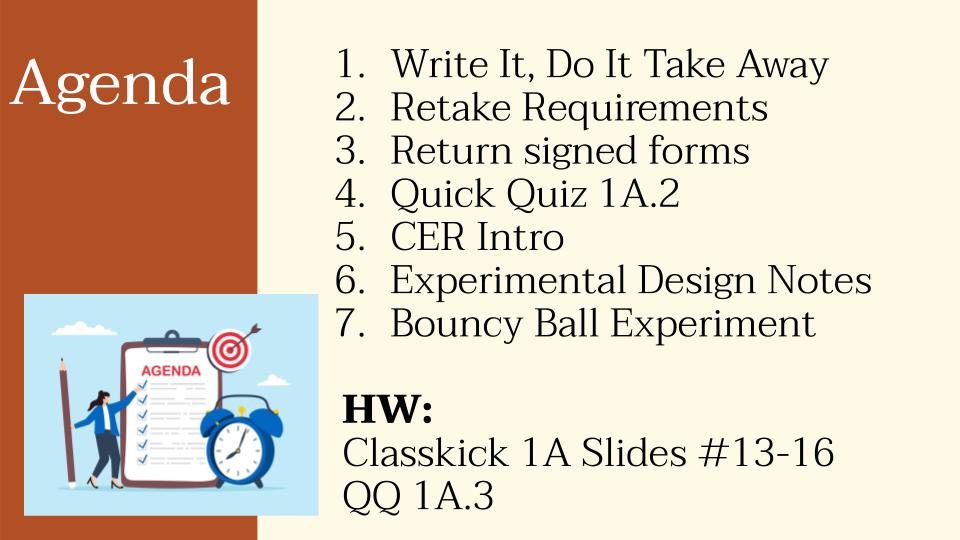
I’m not so sure that the take away of Write It, Do It was really owned by the students. The takeaway was that computers need to be told in clear, specific, and detailed language. The students named some coding languages they have heard of. Personally, I studied Pascal in high school –I’m sure that gives away my age. They did pretty well with the Quick Quiz question of when do we take a QQ – not only did students answer everyday…they also said at the start of every class every day. I love that they understand that it’s part of our routine.

We went over the teacher view of Classkick. I showed how Lovely Llama has not opened up any of their Classkicks and Brainy Bear has completed all of their assignments. I think once they realize that I can see what they’re doing (or not doing) coupled with accessing the retakes, the 9th graders will be more motivated to complete their homework more regularly.

When designing their experiments. I felt like maybe I rushed it. Students understand that the Independent Variable is “the thing you don’t change.” They took that to mean that the quantity can never be changed. I’ll have to reiterate the variable itself versus how much of the variable. Some of the students changed their drop/release height. One group did not change the drop/release height. We briefly touched that everyone’s data looks different. Students said that they saw when the drop/release height increased, the bounce height also increased. No one made a graph. But, it’s only the Day 3. I’m sure they’ll be making graphs in no time.

Next Quick Quiz will be on variables. Crossing my fingers that we get it!