Physics Day 1: Making Squares

Today’s Day 1 (2nd first day of school) of Physics went as smoothly as it could go. I forgot how fun it is to teach the 9th graders as everything in high school is still brand new for them. They came in with a nervous excitement…Ms. Medrano had their seating chart ready to go…

Then we quickly realized that my seating chart did not match the classroom map. That’s okay – we will switch gears and just assign groups to tables. I love that the 9th graders just went with the flow and created new seating groups. One of the teachers threw out changing seats every day. I’m open to that idea…for now.

Students did the Making Squares activity. Some groups had a bunch of different ideas that they documented, others had one idea. They were definitely a bit apprehensive at first, and a few were scared of messing up. I had to remind them a few times that messing up is fine, and it’s just more important to try at this point. That statement gave students permission to try different things. One of the groups suggested throwing the sticks on the table to see if they can magically see squares.

Group that was very methodical and thoughtful about the squares they created together.
Group documented their strategy of throwing the sticks on the table to see if it’ll magically make the squares.

Then…we all signed up for Classkick. Ever since we started using Classkick – I have yet to have a class where 100% of the class followed directions. Block 5 was much better at following directions than Block 6. There has to be a better way on the teacher end to get the students signed up and logged in than the way we’re doing it. This is the portion of the class where my IT special skills get tested, and flipping back and forth between the different operating systems keeps me on my toes! It was also fun to discover in real time that the button for the adding image had changed, but modeling how to react to change for the class was also an important lesson. (We don’t freak out…we try to solve it first THEN freak out if we can’t after several different tries…then google it.)

Once everyone got signed up for Classkick – it was a much smoother class. Students got right on it and worked on their assignments due for the next class. It’s always fun the first few days while we’re trying to figure out what works for everyone. The major positive: students asking questions. I really like it when students ask clarifying questions!

Chemistry Day 1: Save Fred!

Starting a new prep always gives me a certain level of anxiety because of the unknowns. I’m unsure how the delivery of different activities will go and what not. Documenting this round so that I remember for next time.

Classroom Bingo

I found a template on Canva and changed some of the descriptions. I added things like “knows where to get the best tacos in SF” and “lives in the East Bay.” Usually, I’d get 2-4 kids who commute in from the East Bay. I had at least one block of students for which this was not true. Note to self: make sure students can find a friend that fits the description.

Expectations and Norms

After giving students my expectations, they came up with their own class norms. A common theme was respect.

Chemistry students coming up with their own class norms

I wonder if Respect has been a huge issue or if it’s one of the norms that they’re used to hearing. I was hoping that this exercise would allow them to be intentional with the norms they choose instead of knee-jerk responses. We’ll see with how the year goes. Some of the additions like “Be uplifting” is so beautiful. as much as I hear this generation of students described as “soft,” their softness can be a real strength as well.

Save Fred

I seriously thought the students needed 20 minutes to complete this activity. By the time Block 3 hit, they were finishing in 5 minutes. When discussing how they completed the activity using the norms, it’s pretty cool to see how evolved the students are with emotional intelligence.

Students are careful not to puncture Fred.

Syllabus Review

We went over the syllabus. Not completely my style to do this, but the team decided to go over some important parts of the syllabus. Definitely needed to discuss the new grading system—which I’m a big fan of. After explaining it to the students, sounds like they’re also fans of the new grading system.

The big controversy was the bathroom. When I left the school, there was a huge influx of students taking advantage of the bathroom policies. After diving into the issue to find solutions, it seems as though it was a problem nationwide…dare I say worldwide. Students’ days are overly structured—and they’re finding unstructured social time in the bathroom…during class time.

Students asked really great questions. I’m hopeful that this year will be a positive one!

In-Between Spaces

The last two years have been quite a whirl. I started as Principal 3 weeks before I got married. I was pregnant throughout Year 1 of Principal and navigating the new mom status in Year 2. In those 2 years, I never felt settled as an administrator, wife, or mom.

Now, I’m going to go back to SHC with one familiar prep and one new prep. It feels strange and comforting to go back to a school community that I was a part of for 7 years. I’m hoping it will be like riding a bike. As I’m sitting here planning for the year, I’m feeling the same frustrations I did a few years ago. There’s just never enough time to teach everything. Teasing out the important parts and figuring out the essentials for a new prep is a bit daunting. There’s just so much information and fun stuff in Chemistry! I’m wondering if the department ever made a vertical alignment of the skills…that would help in planning.

I’m not really sure what my goal was in writing this post. Maybe, just a moment to reflect on the last two years…and welcome in the energy for teaching Physics and Chemistry.

Year 17: It takes a village

“For just as the body is one and has many members, and all the members of the body, though many, are one body, so it is with Christ.” I thought it would only be appropriate to start a reflection going into my 17th year of education with scripture that was used at our faculty retreat. This year, our retreat was lead by a good friend, Fr. Mark Ruiz, who happened to be my colleague as the 8th grade ELA/Literature/Spanish teacher in my first year of teaching. It has been difficult to completely step away from the computer during the preparations for back to school while on maternity leave. This year, I became a mom at the beginning of the fiscal year, on the first day of contracts for administrators. During this time, I spent a lot of time watching the Olympics and contemplating how mothers before me found success in motherhood. Most of the Olympians, when interviewed, spoke to how their coaches and families helped them achieve success. Mothers reached out to me to explain how they were able to find success, and it’s really through their “village.” Various people dropping by with food, helping with chores, changing dipaers, and other actions of love helped my growing family through this first month. Cluster feeding and sleep deprivation got me thinking about how I made it to Year 17 as an educator, and I have to credit my “village.”

Community in Education

As a baby teacher, I saw Catholic schools more of a private school. I saw that there was tuition to be paid and education was a commodity reserved for those who “wanted” it. As I matured as a person and an educator, I now understand Catholic education to be something accessible by all, and not just the richest, smartest, and whatever superlative that would make a person “superior.” It took a while to truly understand the idea of “We are many parts, we are all one body” from one of my favorite songs for Communion. There is no way that we can all be the same and move forward. Everyone’s gifts, talents, and shortcomings all contribute to something more beautiful–something bigger than the individual.

An example that easily illustrates this idea is that the school can have a lot of brilliant mathematicians who love math. Nobody knows how things when they break down or read any manuals. The school could have a lot of teachers who understand math to teach, but the school would be in a state of disrepair that would not be conducive to student learning. We need to be a diverse institution that includes those who are creative, analytical, dreamers, realists, supportive, and oppositional. We need the parents who will ask the tough questions and make us better, but we also need the parents who will stand behind you and support everything the school asks. We need the students who can pick up information so quickly that it boosts the teacher ego, but we also need the students who need to be held with care. We need student leaders who inspire others, and we need the students who have yet to find their inspiration.

In teaching, it’s pretty common to feel like you’re alone on an island. Often, teachers are the only adult in the room and decisions are caught in a silo. Teachers Pay Teachers is a website that is a pretty clear example of how teachers need each other. Although some days it feels like you’re going through it by yourself, the teaching community is there so you don’t have to do it alone.

In my first year as principal, our adminstrative office staff left their position suddenly. Not only was I teaching the 4th/5th grade combo class, I was in need of someone to be in the front office. So many people pitched in to make sure I felt supported. Parents volunteered to take calls and take care of visitors. Students in the classroom were on their best behavior so that they can complete their assignments. Teachers pitched in and made sure that my students were supervised while I handled principal duties. The Associate Superintendent and Director of IT jumped in quickly to support whatever need I had. Everyone pitched in and offered their talents to fill an immediate need.

Motherhood and Leadership

Everyone talks about a mother’s intuition like it just magically shows up once you become a mother. Nobody talks about the slow creep and how it just takes over one day. My husband and I were elated and overjoyed with our daughter’s birth. They handed the squirmy tiny human over to me while the staff finished up the rest of the birthing process. I knew about the soft spot, the meconium, vernix caseosa, and all the other clinical stuff. But what do I do with this being that was just growing inside me for 9 months?

Much like leadership, I got handed over the reins, and it was time lead. No matter how many published books there are on leadership and motherhood, experience is the best way to go through it. The intuition or instinct kicks in when it is needed. When the baby cried, I was able to identify the baby’s need. When staff members faced conflict, I was able to help find a resolution. In both cases, there are many books about needs and meeting needs. There were days I got it wrong even though I had gotten it right before. In motherhood and leadership, I am learning to accept the consequences (and celebration) of my responses. The important thing is to listen to the experience I’ve acquired.

During the transition of becoming principal and a mother, so many people have come to hold me in some way. A former colleague donated to my school’s fundraiser to let me know that even though I don’t work with them, they will still support me. Family members sent DoorDash gift cards so that I wouldn’t have to think about cooking. Friends stopped by to bring meals. Colleagues put together a gift basket and kind words to share their experiences with new mothers. Parents from everywhere shared their birth stories both the beautiful and horrific. I am so grateful for all of it. Although I consider myself a relatively strong person on my own, I was made stronger with all the wonderful people reinforcing my own strength with their care, love, and kindness.

“Where Faith and Knowledge Meet”

Today, I was asked what my vision is for the school. It is daunting to think that one person’s vision will be used to guide the path of many. True leadership is to accept the joys and burdens of bearing the responsibility of an institution. With that said–I’m working on articulating my vision for the school.

Modern Catholic schools are known to be expensive and almost unattainable by many. Only the wealthy or the very talented can gain access to the quality education Catholic schools provide. We may have forgotten the true spirit of Catholic education–to educate all within the context of our faith. Where Faith and Knowledge Meet is an essential aspect of our mission to serve as a beacon of light in our world, nurturing mind and souls alike.

At the heart of our identity lies the commitment to inclusivity, echoing the teachings of Jesus Christ who welcomed all, regardless of background or circumstance. Our current world encourages division amongst each other and to polarize ourselves based on beliefs. God’s love for us is unconditional. It is not contractual and we will be loved only if we [fill in the blank here]. We were made perfectly, in His image. Therefore, we must recognize the inherent digntiy of every individual, each bearing the image of God, and thus deserving of love, respect, and education.

Education in a Catholic school surpasses mere academic instruction; it is a holistic journey that nurtures the intellect, spirit, and character of every student. As a product of the Holy Cross charism, the idea of formation, information, and transformation has stuck with me. The information portion nurtures the intellect, which allows for intellectual curiousity and the beginning of lifelong learning. The formation of character and who you are as a person, encouraging us to be responsible citizens our world. The transformation of the spirit facilitates our spiritual development and to experience God’s love in a multitude of ways.

In embracing diversity and welcoming all, we acknowledge that each student and family brings a unique set of gifts, expereinces, and challenges to the classroom. Much like the world, each person brings a unique perspective that makes the tapestry a deeper and more beautiful picture of the human expereince. It is our responsibility to create a community where these differences are celebrated, where dialogue and mutual understanding flourish, and where every individual feels valued and supported in their journey of growth.

“Where Faith and Knowledge Meet” is more than a motto; it is our guiding principle that shapes every aspect of our educational mission. It reminds us that faith and reason are not opposed but complementary, that the pursuit of knowledge is enriched by a deep grounding in faith, and that true wisdom arises when the two converge. In living out this mission, we are called to be ambassadors of Christ’s love, extending hospitality to all who enter our doors, and bearing witness to the transformative power of education rooted in the Catholic faith. In doing so, we not only fulfill our duty as educators but also contribute to the building of God’s kingdom, where all are welcomed, valued and cherished as beloved children of God.

Year 16, Week 8, 1st time Principal

For my 16th school year, in the year 2023, I literally answered a call about considering moving from teaching to administration. After much thought and conversations with my now husband, colleagues of past and present, and of course school leadership, I said yes. From when I said “Yes!” to Week 8 into the school year, I didn’t have the smoothest take off and had a hard time keeping the plane in the air.

“I Am With You Always…”

The theme that the Department of Catholic Schools came up with this year is from the book of Matthew: “Go, therefore, and make disciples of all the nations, baptizing them in the name of the Father, and of the Son, and of the holy Spirit, teaching them to observe all that I have commanded you.  And behold, I am with you always, until the end of the age.” (Mt 28:19-20).

Admittedly, I didn’t read the whole thing. I only read what stuck out: I am with you always. I have been thinking about that quote since it started, and today, in the quiet of the Santa Cruz evening, after breaking bread with colleagues…it finally made sense to me. Throughout our meetings and communications, someone always has something that goes back to the theme, but nothing really stuck with me.

As teachers, we embark on the journey of learning with our students. Sometimes, we teach them something. Sometimes, they teach us something. Best of all, when both teachers and students discover something together. As educators, we take that walk with the students despite how difficult or easy the path is. Sometimes we offer a hand or a walking stick, but there will be times when we have to carry them (or as some say drag them to the finish line).

This is the beginning of the journey, and many administrators before me have shared how lonely of a road this is. As teachers, I could always count on a good faculty room/Happy Hour to commiserate and share stories with friends. As a principal, I could tell my teachers what I really think and break that professional wall (highly unadvisable). I could also talk to my fellow principals, but they don’t really know what I’m talking about as I wouldn’t truly understand their woes. I definitely call my associate superintendents, and they can listen and offer advice. Despite all of this, knowing that there are people walking with me and finally seeing that I am not alone. God, Jesus, Holy Spirit, my fellow administrators are all walking this journey with me.

Special thank you to all the folks that let me call them on my drive home to listen, allow me space to vent, and to catch up on life. You have truly made me feel connected.

Pace Car

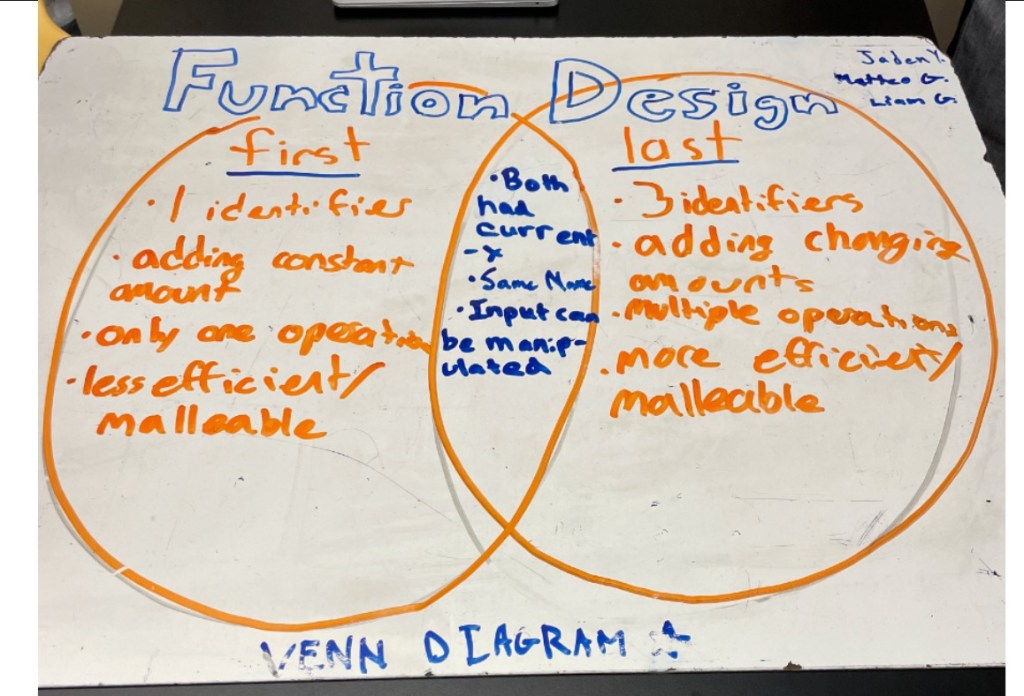
I was very nervous to start Pace Car. When Mrs. F and I originally learned to do this activity, I believe some tears ensued. I did warn my students that tears may fall during this learning exercise, and it might be me (again) or them (maybe again?), but that’s part of the learning struggle for right now. We completed the table using current velocity (v) for Top Car. It was then discovered that Top Car had too little of a delta-x when using current velocity as part of its next-x equation: next-x-top-car(x, v): x + (v * delta-t)

There was disagreement whether or not to use current-v versus v when representing current velocity. However, my students were just lucky to end up with the efficient (lazy?) teacher who didn’t want to write “current” repeatedly. Mrs. F and Mr. R went with the current-v notation. I’m not sure if that brought anymore understanding to the whole Pace Car activity, but it brought upon confusion when our students tried to help each other out. There was some audible debates that went on with which notation to use.

For Middle Car, we used next-x-middle-car(x, v): x + (next-v(v) * delta-t). It was at this point that the students had trouble differentiating between “next-v times v” and “next-v of v.” At the beginning of discussing Middle Car, I found out how intentional I really needed to be with my words. We talked about the function notation and how f(x) looked like next-v(v). From here on out, students started to refer to next-v(v) as “next-v of v” and trying to multiply next-v and velocity decreased by a lot.

When we got to Bottom Car, the students intuitively knew to find the average between current velocity and next velocity. After talking to Mrs. F, I realized they didn’t actually understand WHY and how finding the average worked out. The next class, they learned a little calculus. We talked about how the velocity is different at every point between 3s and 4s. We arbitrarily picked the numbers 3 and 4, but I’m not sure if the students can be flexible enough to shift their thinking for other intervals. Anyway, we talked about how there is the possibility of having an infinite number of points (velocities), and how nobody has time to find the average for an infinite number of points in a time interval. So we decided as a class that we would just pick the beginning of the time interval (current-v) and the end of the time interval (next-velocity).

The code for Bottom Car ended up being- next-x-bottom(x, v): x + (avg-v(v) * delta-t). Some of the students found out really quickly that they’re going to have to use the whole definition of average velocity.

We’re taking our Pace Car Quiz this week, I’m going to see how well we did in presenting Pace Car this way.

Day 30: Quiz and turning our motion maps

We’re about 10 days out from taking the final, and we’re just now taking the first quiz for velocity. During the next-x discussion, a lot of the students LOOKED like they were paying attention. There were lots of copying down whatever was being written down on the board. However, today, after looking at the quizzes that were turned in coupled with the questions that were asked during office hours, it does not seem like we actually understand the next-x function.

I asked some students to explain velocity, delta-x, and the next-x function and how it’s all related, and there was a lot of challenge articulating how they all work together. I forgot about the video that the students watched about Independent and Dependent Variables. Because the students are 9th graders, most students have had some sort of instruction about IV and DV. It was pretty exciting to some that they recognized something from previous classes. The most we got in our discussion is that they drew a second axis line. The students have their motion map axis (which some have named as position) and the second axis line (that some figured out is called time).

Next class, I’m hoping to move the data points so that they can see a slope on their newly formed graph.

Buggy Lab & Simulated Motion

Started Unit 2 with a lot of grief. This year, Unit 1 ended with a lot of…fireworks. The Physics team reworked the Summative that we had created during the Zoom school days. It turned out that it didn’t necessarily work with our 9th graders this year. We’re rethinking the Summative, and instead of a project, they should just go ahead and do a test.

Buggy Lab

We started Buggy Lab pretty strongly this year. Now that I knew what to expect and where the pitfalls in the directions may lie, it was much easier (AND faster) to execute the activity. There were only 1-2 groups this year that calculated for the distanced traveled by the buggy instead of recording the position of the buggy. I believe last year, we had at least 2-3 groups do this in every class. So I’m getting better at making sure the students get the right directions.

The students recorded on receipt tape (that thankfully I purchased some extra rolls). Note to myself, the receipt tape does not need to be thermal paper, but the markers do show up better on that type of paper. I had them save their receipt tapes…just in case, but now I’m realizing we saved the number lines last year because it took us 2-3 classes to figure out the activity.

Simulated Motion

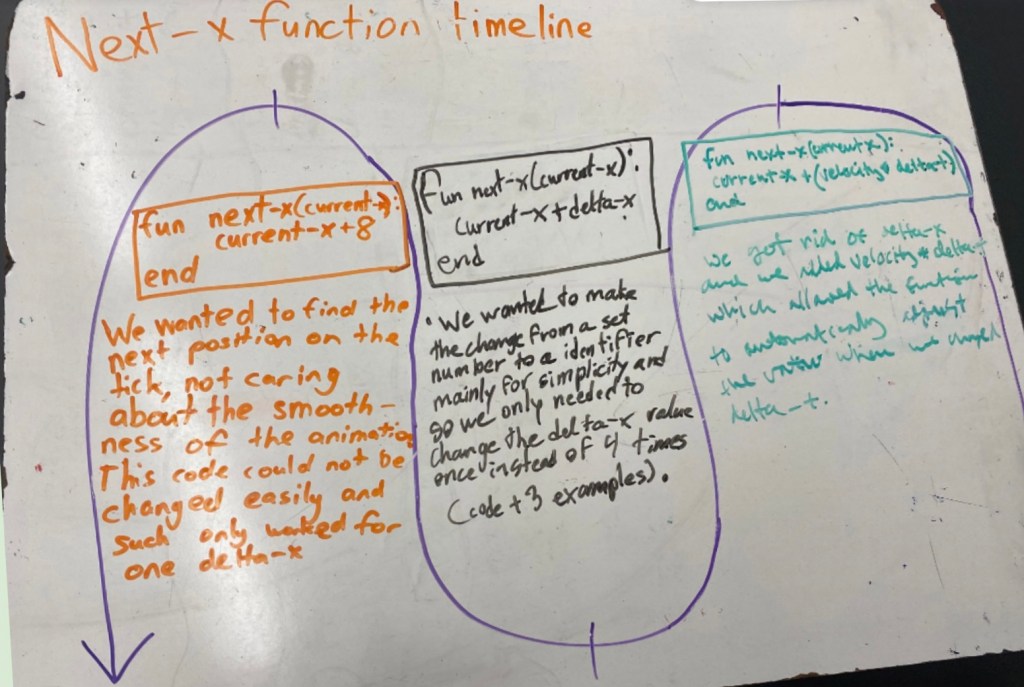
After the Buggy Lab, we jumped into the next-x function. Thank goodness that Mrs. F reworked the Activity worksheets so that it was easier to get the point across. The entire class used the sample data to look at the simulated motion. This year, I had the students whiteboard the evolution of their understanding of the next-x function to get them thinking about their thinking process. During the whiteboard discussion, some misunderstandings came out. For example, students thought that the value equal to delta-t matched the input from their first example. Another misunderstanding was that the delta-x is velocity.

I really appreciated how their change-of-position value progressed to become delta-x which then became (velocity * delta-t). I loved how some of the students got really creative with their interpretation of the next-x journey. But the best of all, the students who participated in the discussion understood how delta-x becomes velocity * delta-t.

Day 11: Game Day and Flag Drawings

Game Day: System Schemas & State Diagrams

Since I gave my test a day later than the other teachers, I had to create my own problems and make it just different enough. Introducing the conditions earlier caused some focus to be diverted away from the drawing system schemas and state diagrams. Students focused on weird details and not really the big picture. Grading it is kind of tricky for me mainly because of what I really wanted students to focus on vs. what they actually focused on.

Draw a Flag

We started drawing with Pyret. I know that Bootstrap Algebra does this exercise, so I’m glad that the Algebra teacher who is using Pyret and I went over the exercises and the verbiage we’re going to use. We didn’t think that the redundancy in exercises would be useful, but definitely agreed that we should call things similarly and emphasize the way we use words.

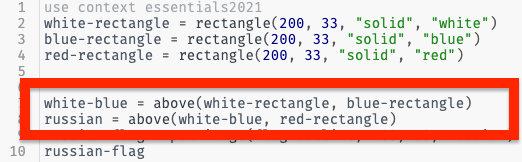
Overall, I’m finding that the students were having a hard time breaking down the flags into shapes. For example, the Italian flag, they saw it as three shapes laying on top of each other. Whereas, myself (and kids who think like me) saw the flag as three differently colored rectangles beside each other. And then with the functions that took in 2-arguments, students had a hard time seeing they can draw 2 things and write an identifier that draws those two things and then do the same thing for the 3rd thing. For example, the Russian flag. I had a couple students who couldn’t see that the white rectangle on top of the blue rectangle can be one shape.

Students had a really hard time with combining two objects to make it one object.

I’m not sure how I can make the thinking better of writing an identifier to make two shapes become “one” shape. I think it’s like counting. one is one. I don’t know how to teach the concept of one. Thank you to all our teachers who cover this concept. I’m having a hard time having students that if you combine two things as one identifier, it can be “drawn” together as one.