Gabel Reading
We discussed how in 1996, when this article was first presented, there was a call for more Chemistry Education Research, but here we are in 2026…saying the same thing. The conclusion I ended up writing in my notes was that students will ask themselves: How do I know this is factual? It critiques that the way traditional chemistry class is organized for students makes sense for the teacher who already has an understanding of chemistry. Rather, we should think about reorganizing the sequence of topics presented to students as it fits their learning journey. Teachers have the schema to understand that the traditional sequence of topics is logical, whereas, students do not have that operating understanding and will not be able to make sense of why things go in the order presented. Rather than having a true understanding, the students will just have to accept that the “sage on stage” is presenting facts and they’ll just retrieve it for the test.
U3 WS 1: Describing Thermal Energy Changes
We worked on completing WS 1. Some takeaways were:
- Energy is a construct. It is in the sense that everyone understands it exists, but it can’t exactly be described as any one thing.
- Energy can be analagous to money. Money can come in different ways: paper, plastic, coins, etc. However it looks, it can be accepted as currency if you were to try to purchase something. It is a construct in the sense that it’s made out of paper and we, as a sociey, has assigned value to this piece of paper. The example given was a $1 bill and a $5 bill. They look the same and could argue that they’re exactly the same, yet one is worth 5x the other. Energy can be stored in different ways (it can go in a checking account, savings account, and wallet).
It was here that the LOL charts were introduced. We used to have students complete them in Physics, but not completely sure when we stopped doing it that way. We do Energy Bar charts, but we don’t really look at Work. It looks like I might have to reintroduce them next year so that they’re going to be used to them when they get to Chemsitry.
U3 Lab: Energy and phase change
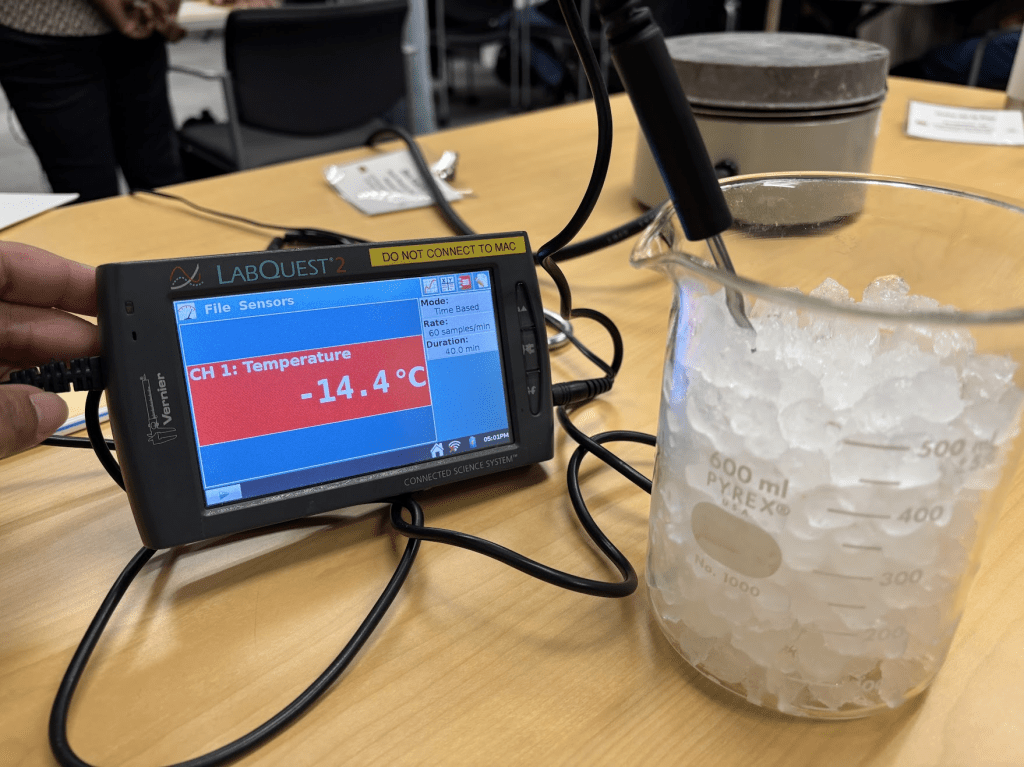
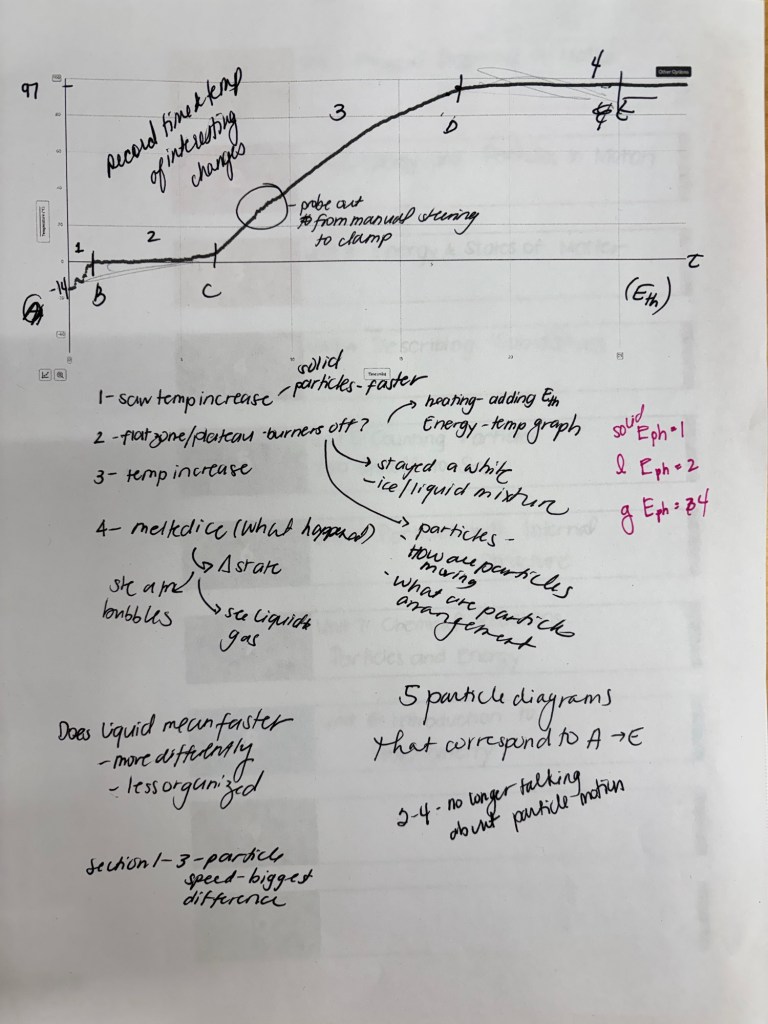
For this lab, we needed a temperature probe, LabQuest, hot plate, beaker, and the “good” ice. We were instructed to set the Data Collection to be Time Based for 40 minutes and to collect 60 samples/min. After capturing our initial temperature, we made a prediction of what our graph might look like. The graph that came out did not look like our predictions!
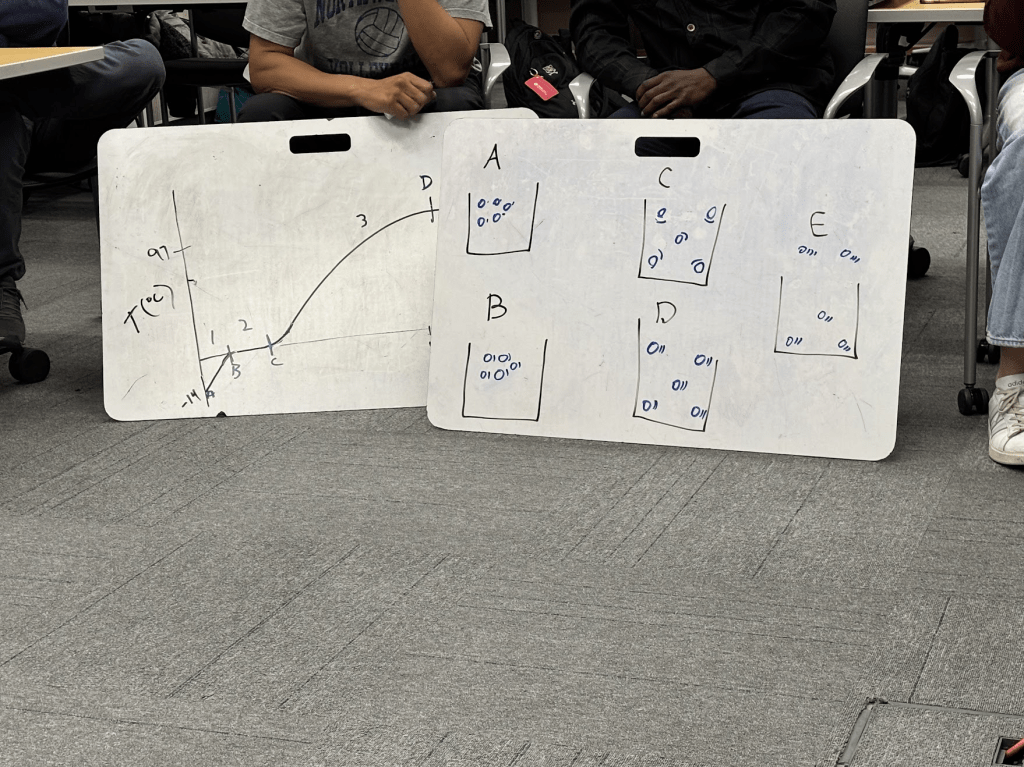
First, we were asked to look for similarities between all the boards. We were guided towards including a new convention of structure and motion of particles. We talked about how the number of whooshies can indicate which phase/state the particles might be. We also agreed that solids were much more organized than gas. One of the questions asked during the Board Meeting: “Are tehse solid or liquid? Are these particles any different?” I thought that this was a great question to ask in order to differentiate that the particles are still pretty close together. It was here where we introduced the Eph (Phase Energy).
U3 WS 2 & 3
It feels like we jumped into working out WS 2 and WS 3, but looking at my notes, there was actually some scaffolding of understanding to get us there. When we had a Board Meeting for WS 2, one of the groups took on the role as teacher. In student mode, we were asked to complete the question of drawing particle diagrams for what’s in the bubbles during boiling water. I held onto that misconception that air was inside the boiling bubbles. The group did a really great job of breaking that misconception. We determined that the things we see coming out of the beaker of water were streams of vapor. And when we hold our hand over the top, there’s a collection of water particles that will feel welt on our palm. This is evidence that it is actually H2O(g) and not air floating out of the beaker!
WS 3 proved how much I did not understand thermal energy as an undergraduate. HOWEVER, I was really good at dimensional analysis and could write the givens and cancel units out until I got the correct answer. So, it was a little frustrating that I couldn’t math my way out of truly understanding thermal energy. As I completed the worksheet, I kept thinking- man, it would be really helpful if we were forced to draw a particle diagram, include the heating curve, and/or a proportionality table.

U4 Start: Demo, Video, Electrolysis
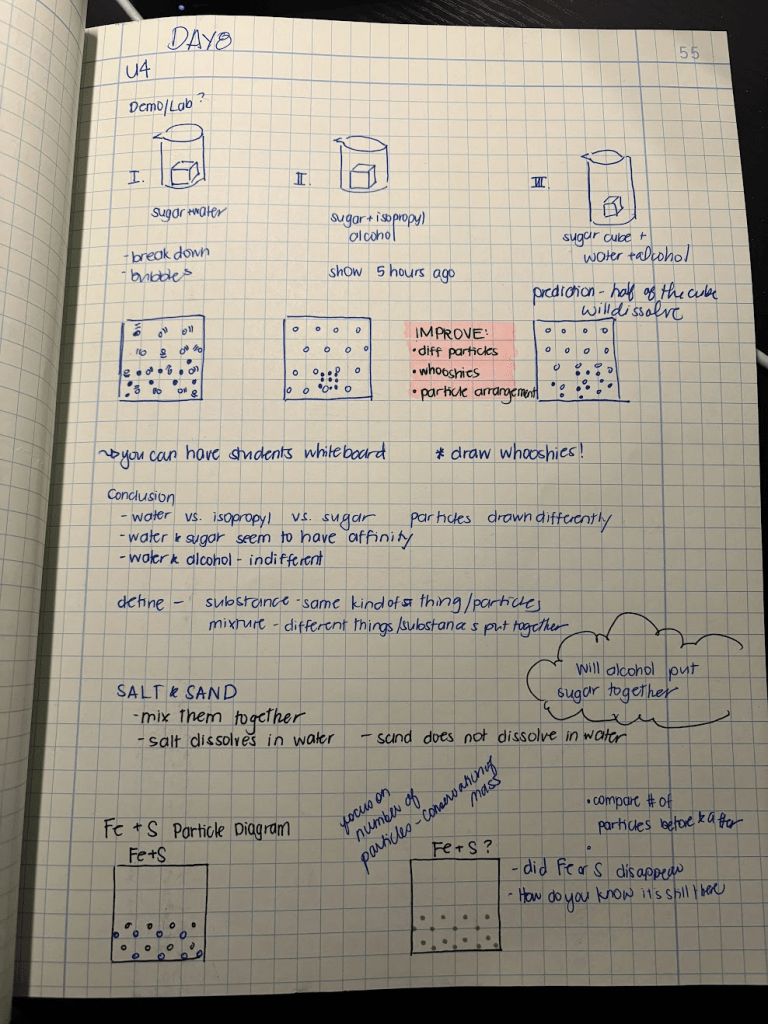
We started with a sugar cube and water was poured into it. Beaker 2 had sugar cube with isopropanol. Beaker 3 contained a sugar cube with 50/50 water/isopropanol mix. We wrote observations for all three situations, then draw particle diagrams. At this point, I already forgot the agreed upon conventions for the particle diagrams. I did not differentiate between the water and alcohol particles. I also did not draw whooshies for any of the particles. Particle arrangement was also something that needed to be paid attention to. We talked about how to maybe separate out water, sugar, and alcohol–how easy might it be to separate all three things?
Then, Mitch had a great (hopefully very practiced) demonstration of mixing salt and sand together. Then, we were asked to brainstorm some ways to separate them?
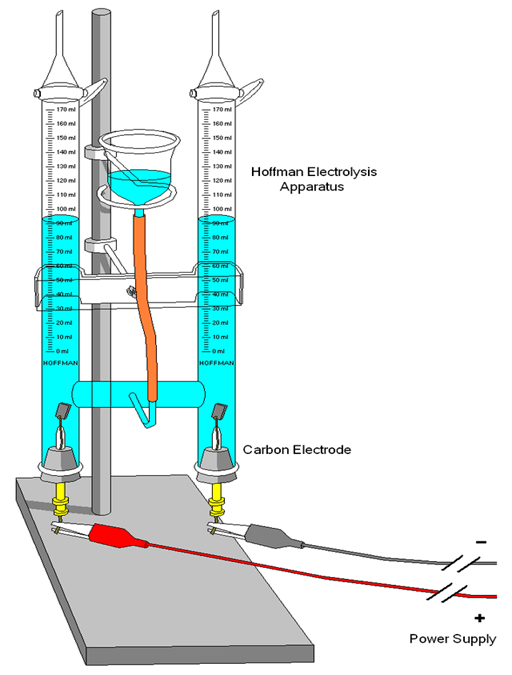
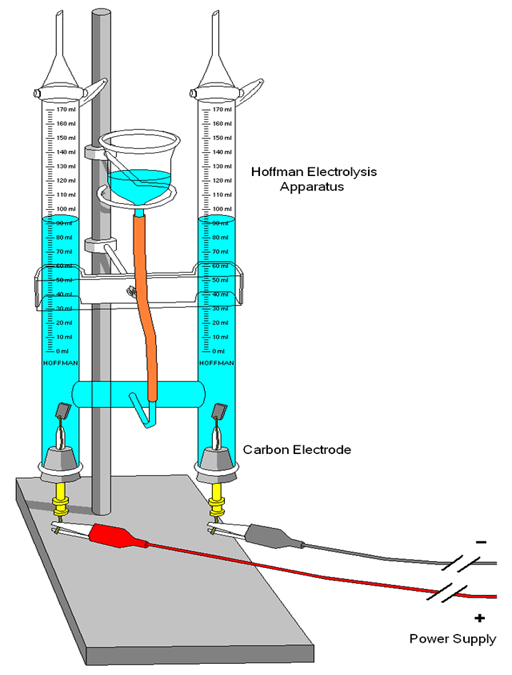
The conversation naturally then went into separating things from a compound. For example, H2O, is considered a pure substance and could it be broken down? The answer is yes, we had a demonstration using the Hoffmann apparatus. We were able to collect the H2 gas and the O2 gas, then used a match to test to see if we did collect the gases we thought we did.
We ended our day with Fe + S and what the difference is between a mixture of Fe + S and compound. I’m going to ask tomorrow what the new convention might be for something that was “created.”
 Learning with Ms. Medrano