
Learning Styles Reading Discussion
We had a pretty spirited conversation about the use of Learning Styles in education. So much funds and monies have been spent on workshops, resources, etc. to incorporate learning styles in the classroom. As an undergraduate student, I do remember one of my Psych professors saying that people may have a preference for a certain kind of learning method, but it is certainly not an excuse to ignore the other modes. This just led to confirm that Modeling Instruction is so valuable because we ask students to represent their learning through multiple modalities. In every representation, the story needs to tell the same thing…and it is pretty fascinating that students often cannot get their representations to reconcile.
Unit 4: WS 1- Mixtures and Compounds
We completed and discussed WS1. In order to save on time, we did not execute a Board Meeting to tease out important learning objectives. It is at this point that students will need molecule, elements, compounds, pure substances, and mixture defined. We were given a series of particle diagrams and we had categorize the diagrams into element or compound, pure substance or mixture. I can now appreciate some of the ambiguity that some of the diagrams had so that you can elicit conversations from students.
Unit 4: WS 2- Avogadro’s Hypothesis
At the same pressure and volume, the gases contain the same amount of particles. We had a hard time with this worksheet because it was tough to see that each volume of gas would all create one volume of gas. So, we kept going back to the statement: At the same pressure and volume, the gases contain the same amount of particles. We watched the video: Chem Study: Gases & How they Combine to help us see solubility of gases.
Dalton’s Playhouse
Dalton’s Playhouse showed us how an experiment may have been carried out to lead Dalton to the development of his atomic model.
Unit 4: WS 3 & WS 4
We were BLASTING through Unit 4. We worked on on WS 3 and WS 4, and then it was the end of the day. I really liked how we had to set up the mass ratios to figure out what the ratio of each element might be in a chemical formula. I’m foreseeing that it might be hard for students to see the ones that aren’t exactly clean. For example, (numbers not from the worksheet) 0.83 and 1.66- I’m not so sure students would be ready to see that’s a 1:2 ratio. I’m worried about when it gets to 3 or 4 too! Number sense is SOOO important.
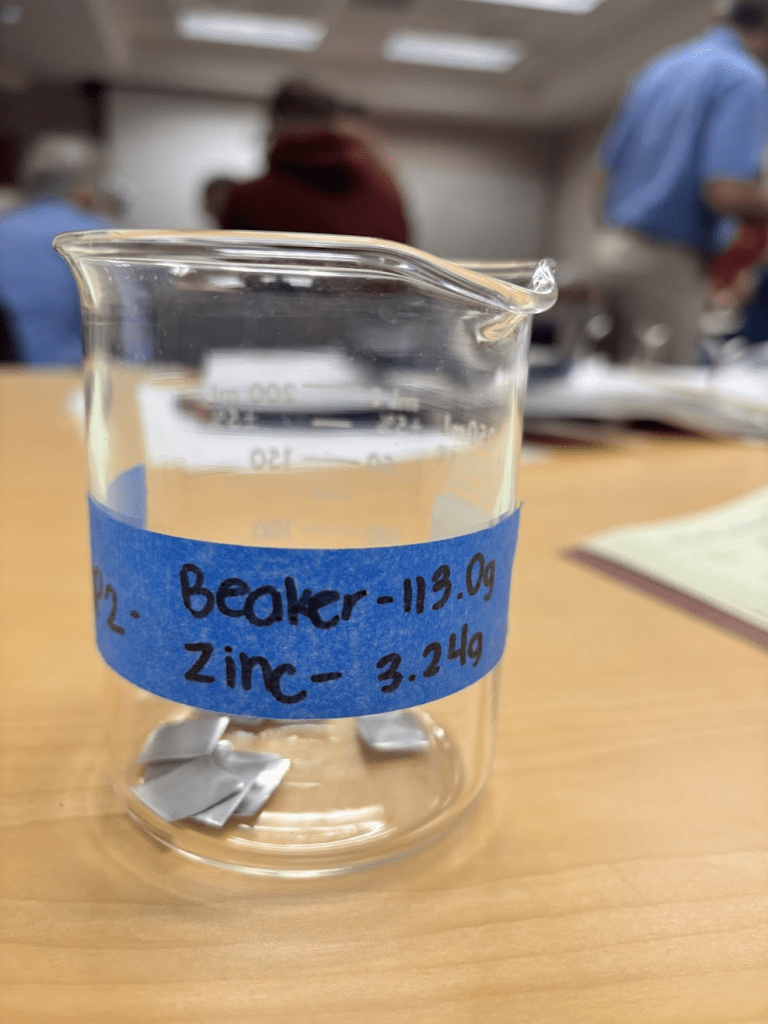
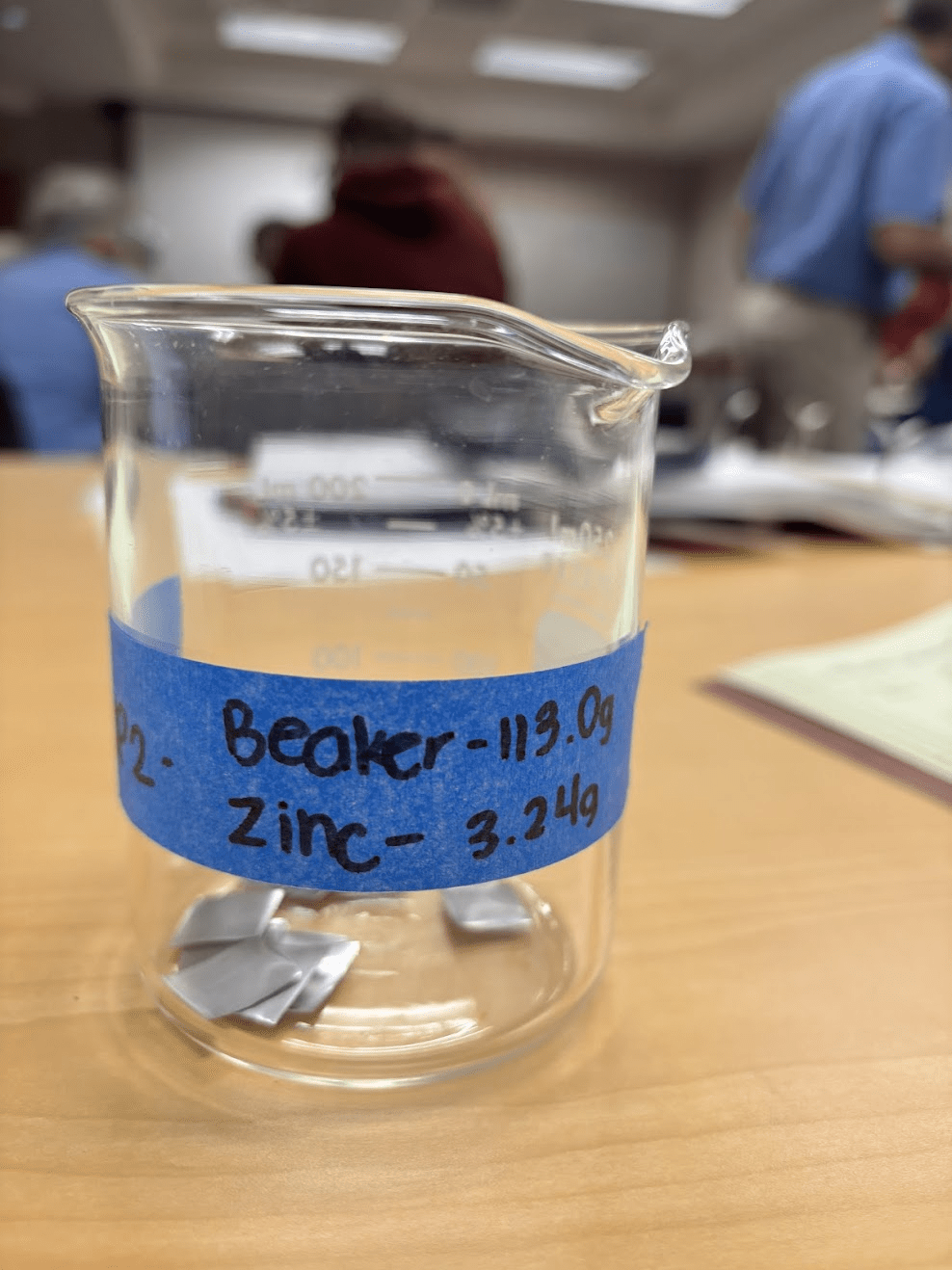
We started the zinc lab so that Mitch can have time to boil the excess liquid and dry the leftover solids.

