
Scale Reading, Uncertainty, Sig Figs
We quickly reviewed the SigFig rules, but I definitely felt unsusre of myself. It may be how my students might feel. I keep forgetting which trailing zeros count and which don’t. I really like how my learning partner, Rich, showed me what would count as “significant.” When completing the Scale Reading and Uncertainty worksheet, I thought that there would be a definite answer for uncertainty. It wasn’t until someone commented on our lab technique to see the meniscus of the water better did I realize that the uncertainty value could be entirely personal.
Lab: Density Lab

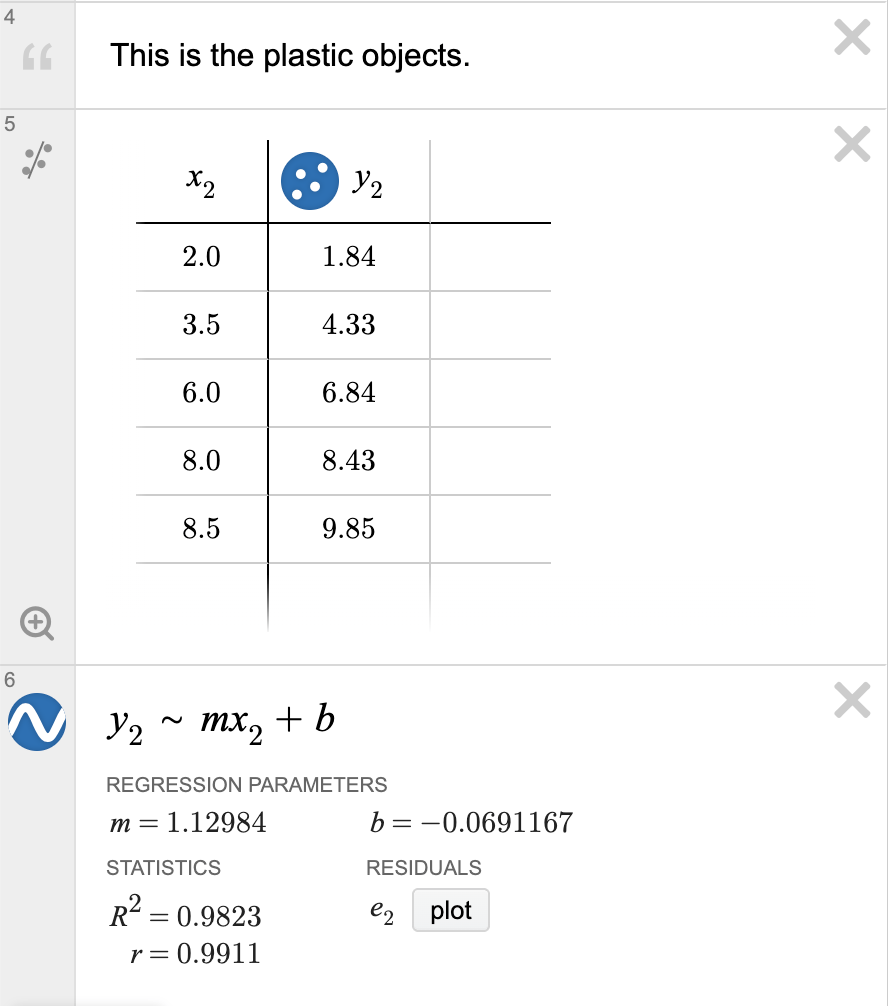
We collected data for the plastic objects in a different order when we recorded the mass and volume. This lead to a graph that did not make sense. It was only after we stared at our data for some time did we realize that we should have completed it the same order. If I do this in the classroom, I might number the objects somehow? Label them, but I want to refrain from adding another substance. Maybe I can engrave them with the help of the Engineering department.
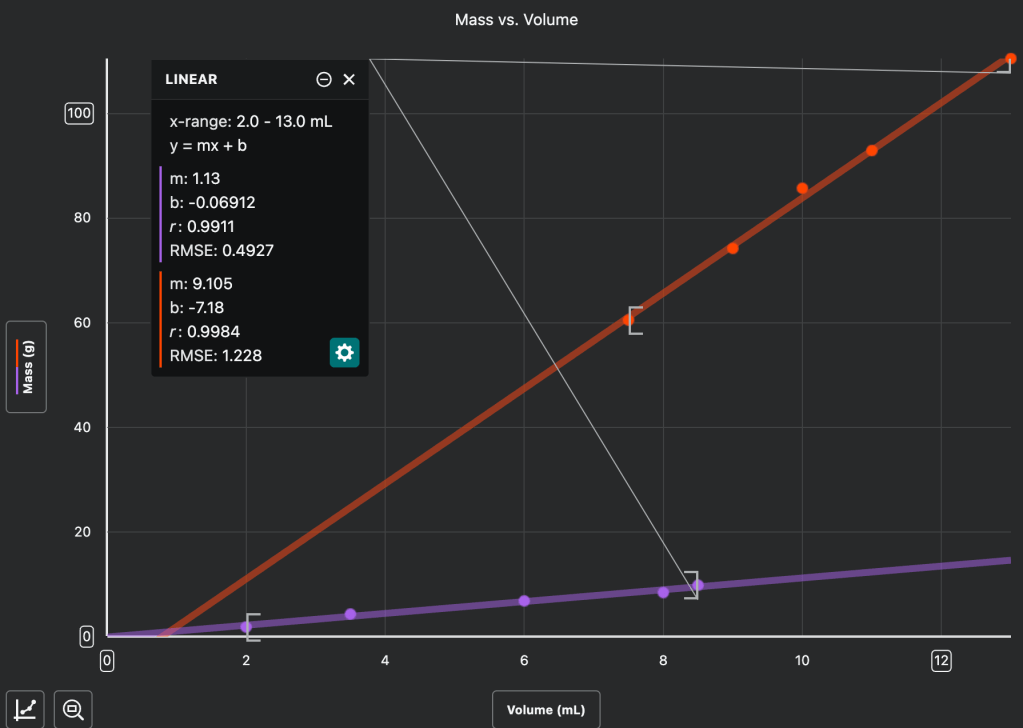
The Density Lab was limited to two materials. I believe when we did it last year, the students had to figure out the density for a variety of cubes. Then, for the irregular shaped objects, we kind of told them what the item was. Students would just need to look up the density value. I was struggling with creating my graphs on Graphical Analysis.The graph itself was created, but I couldn’t get it to do the linear fit. It was only after I completed my graphs on Desmos did I realize it was because there was a user error. I was trying to use Manual Fit (which needs the Pro version), but I needed to use the Apply Curve Fit.
Mitch talked about using the word equivalency when comparing the mass value to the volume value. Then he picked up another item and said that next item’s mass value is equivalent to its volume value. I did freak out and disagreed vehemently with him. I argued about it for a while (in my head). During lunch, I came to the conclusion that I actually liked it. Students struggled with the molar mass idea and could not understand how 1 mole oxygen is equivalent to approximately 16.00 g of oxygen. So now, I’ve decided I do like talking about how that item has equivalent values that doesn’t necessarily mean “equal to.” We whiteboard and had our discussion until about lunchtime. To me that means that would be may 1-2 class periods of the actual lab and then 1-2 class periods of whiteboard? We do not have the luxury of time, so I’m going to work on figuring out how to shorten the time it takes to do these activities.
U1 WS3 – Density
We worked on U1 WS3 – Density problems. Working on the worksheet + whiteboard discussion took the rest of our afternoon. My group members introduced the pHet simulation of Density. I like it because it made it obvious that we had to get the whole object to be submerged. During the Whiteboarding I did bring up that I saw aluminum had a density > 1 g/mL and the question one of my students had about why their grandpa’s aluminum boat didn’t sink. The approach of asking whether or not the boat was a solid shape (like a cube or a ball) came up. Then we went over and ended the day here.

