
Hestenes Paper Discussion
Lab: Gases
There wasn’t much given in terms of how to do the lab. There was no write-up of the procedures to follow. Because it was one of the first tasks of the day and I’m not taking 5 other classes, I was able to follow. I wonder if I should give students a general thing that’s written down, project the setup on the screen, walk through the setup, and then allow them to figure it out. Luckily, my partner was able to remember what we were supposed to do.
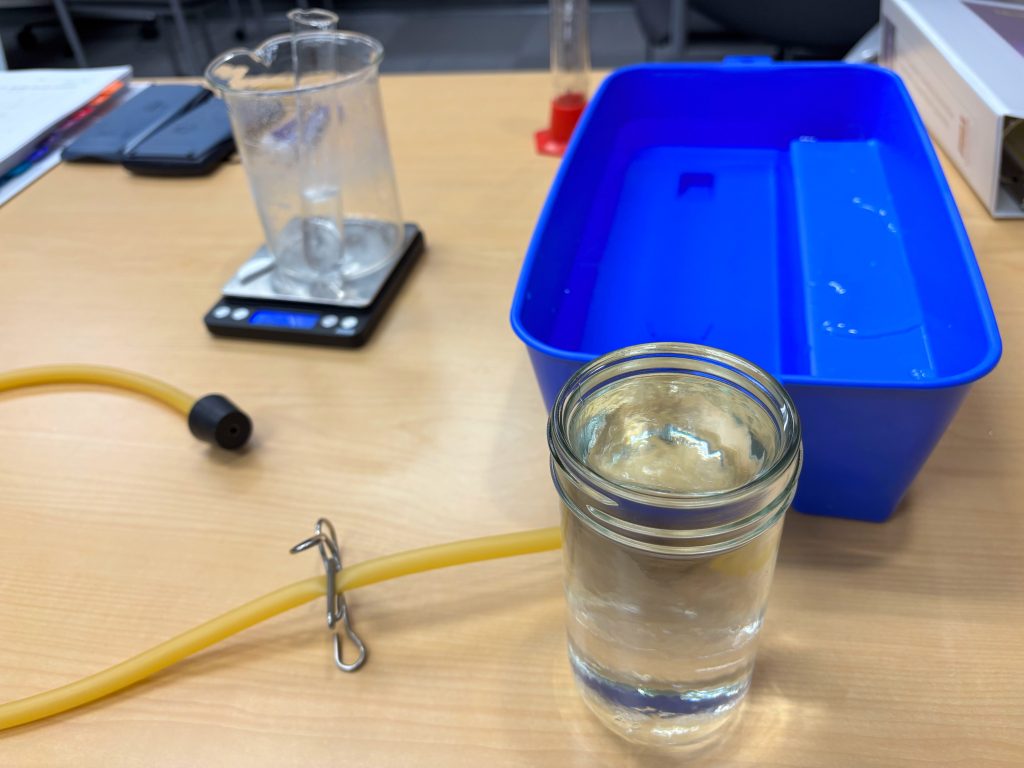
He had the beaker, test tube, and alka-seltzer on the scale. I just needed to fill ⅓ of the test tube up with water. So this would be the massbefore. To complete our apparatus, we needed the jar filled with water and the trough to be halfway full. It was very important that we clip the hose connected to the hole so that we wouldn’t spend our lab time cleaning up water.
We covered the jar with a plexiglass square. Then flipped it over and put it into the trough over the hole. I slid the plexiglass square out from under the jar. I was not completely successful in making sure that all the water stayed in the jar and we ended up with a small air bubble at the top. Mitch assured us that it was negligible, but also to include that information if our data came up horrible. Rich was in charge of quickly covering up the test tube. I had the job of dropping the alka-seltzer into the test tube and then removing the clip so that the air could travel through the hose.
We collected the massafter by allowing the reaction to complete before removing the stopper and reading what it said on the scale. I feel that it was smart that we kept the beaker/test tube thing on the scale so that it could remind us to read the massafter. We collected the volume of CO2 by measuring the amount of water before and after the reaction. Our final density value was pretty close to the accepted value of CO2 gas. We started to discuss if dry ice which is CO2 (s) would have the same density as CO2 (g). Even though they’re made up of the same particles, would they have the same density? We were asked to draw a particle diagram of CO2(g) and CO2(s). If the substance changes states, would it still be the same particle? There was some discussion about making it an opportunity to use proportional reasoning for this moment. Otherwise, I might get students to draw 21 particles in 1 mL square and 1500 particles in 1 mL squares (like I did). The result was: when vaporizing something, it’s a space issue and not a separate substance issue.
Lab: How thick is this aluminum foil?
This was such an elegant way of going from macroscpic measurements to scientific notation because of how small an object is. It was an easy way to introduce scientific notation and how to remain consistent with SFs. I really liked that students had to find their own way to figure out the thickness of the aluminum foil. We decided that we could measure the length and width of foil, and then use the Volume formula to find out the thickness of foil. From the data collected, we discovered that foil had 2 different thickness. Actually, we were given two different kinds of foils. What might explain the difference? Could individual atoms be that large?
U1 WS5 – Relationships Between Units
Working on WS5, I couldn’t help but do the problem using dimensional analysis. I’m in love with the DA train I learned in high school. When I started using the tables to show my work, it reminded me of how we used to do x-t tables and students need to show the Δx and Δt and from there, they get their slope. It bothered us so much that there were no tables to show our work that I just went ahead and revised WS 5 to include tables.
During the WB discussion, there was looking at the change across the equal sign (different units) instead of vertical (same units). I kind of like across the equal sign because it establishes the ratio, but I like the vertical–because of the mantra: What you do to one side, you do to the other.

