We had a Physics Learning Team meeting, and we looked over where we are today compared to what we did last year. We are behind. I know that we took an extra day to make sure we really knew how to write the Claims and Evidence for the CER (Claims, Evidence, and Reasoning). However, I’m unclear to where the time went.
Last year, we wanted to include a Proportional Reasoning lesson because we do a lot of Proportional Reasoning thinking throughout the year. This year, was Take Two for this lesson. At the beginning, most of the students seemed to be tuned out because the math was so easy. We made it easy so that we wouldn’t be teaching math, but the proportional thinking. Because I lost so many of them so early, maybe we should make the math part a little bit harder.
This was the first question we gave after the Proportional Reasoning Intro. Here is the Proportional Reasoning document: Proportional Reasoning document. Then we gave this as the first practice problem. The first block informed me that I needed to go over the meanings of coefficient and variable. Then we went over how to isolate the variable by using the opposite operation. Once we got to the algebra, it was easy enough.
Both Mrs. F and I decided that we should include some sort of table. Such as this one to the right. It was much easier to see what the coefficients are. However, it wasn’t so easy to see the coefficient that match the variable. Also, it was hard to see that delta x is one variable.
There are still quite a few kinks to work out, but I think we’re getting better each year.
This year, I also made it a requirement to reflect on how we did on the quiz PLUS what we can do better next time. Students who got a 100% saw it as something that they didn’t need to do. However, with growth mindset, we can always do better or improve something. Somehow, that message didn’t come across as strong as I hoped it would.
MHT students went across the street to the DePaul campus to see the construction of the chorus room. It was supposed to be ready by the end of the summer, but there were some complications. One of the main complications was that the hole (or something like it) required by HVAC could not be supported structurally. The design team had to then go back and redesign it so that it would fit all the requirements. Another complication was that the door needed to be bigger. I’m also writing this a week and a half later, so my memory of what happened isn’t great.
What I do remember are the students becoming obsessed with building codes. Someone asked about building codes for ADA and for residential. There were a few students who were trying to make prison cells as dorm rooms, and it turns out that there are requirements. (It was a great lesson in treating every person humanely.)
Overall, the students learned some things that were incorporated into their projects. They do presentations tomorrow. (This part I’m really excited about!)
We took our very first pencil and paper quiz. Students had to convert mat plans to iso/ortho views of the structure. Most of the students did well. Quite a few misread the front. I think we’ll have to review where the front is on a mat plan. Very few students struggled and asked for cubes so that they can have it in their hands. The point of this was to visualize without the cubes as aid, but I’m still conflicted about taking that away from them.
Their isometric name projects were due today. Most of them did a really good job. Here are a few of them.
I’m really pleased with how creative the students got with their names. I encouraged them to let their personalities show. Some (very few) took the opportunity that I gave in class to get started on their name projects. For the most part, I think they came out really great!
Then I had students work on their college dorm buildings. There was still a lot of brainstorming happening. I tried to get them to see that they needed to start drawing so that they can meet the September 19 deadline. I’d like for them to meet the deadline without being under great stress. Somehow, time management skills need to be incorporated into the teaching…not just an after thought.
Here are some photos of their progress:
We had a discussion on the importance of creating a building beautiful and functional in AND out. One of the groups decided they were going to build their dorm inspired by the UC Santa Cruz banana slug. (Goooo Slugs!) One group used 3D Builder that came with the Microsoft Surface to do the drawing. Another group used Fusion 360 to do their drawing. Next year, I’d like to use Fusion 360 or SketchUp to complete these drawings.
All my Physics related blog posts are probably going to start with I hate how Schoology is down for our freshmen class. It’s really throwing a wrench in my organization and work flow. Over the long weekend, we assigned some homework pages that are meant to be practice for students about graphs and equations. I had quite a few miss the homework because they didn’t have anywhere to check to confirm what their homework is. Over the last ten years, my philosophy on this has changed significantly. It should have been on the student to complete their homework, but if they don’t know what’s for homework, then how can they complete it? Argh.
We ended up whiteboarding the homework. It was the original plan, so it was totally fine. The students did wonderfully! I’m so proud of how they all came up to present their problem and answered my questions wonderfully. There were some common misconceptions that came up like making graphs have even intervals. Another common one was that the cyclists had the same velocity at the moment the lines intersect (on a x-t graph). For the most part, it went well. I think students understood it more. I did get one student who was convinced that the negative slope meant that the cyclist was slowing down. We went back to the buggy lab conclusions and most of their peers were really excited to show how the negative slope meant the opposite direction.
I really enjoyed seeing the students work together on their whiteboards because they wanted to do a good job.
Today, I introduced our big building design project. In the past, students were required to design a building, any kind of building, using all the pieces that come in the Lego Architecture Studio box. Students were not allowed to create pools out of leftover pieces. What ended up happening last year is that students built their buildings without having a plan. This year, I decided to give them a purpose.
As an alumni of UC Santa Cruz, I receive some emails and news including the one about the university asking faculty members to open a room up to students due to the sever lack of housing available. Because this class is made up predominantly of seniors, I thought that this might be a good way to introduce buildings. I found an article of a study conducted by Hare Kiliçaslan (I tried to copy and paste the name from the article) of Design of Living Spaces in Dormitories. It’s a short and easy to understand enough article that I felt comfortable giving it to seniors without having to break it down as a class. They used the article to inform them of design choices.
Some of the students were excited by this endeavor and got to work by drawing on the whiteboards. Others were excited by the idea of creating a dormitory space in a part of their favorite city. Some students were more slow to start because it was overwhelming. One question in common was does it need to be affiliated with a school. Meaning, can UC Santa Cruz dorms be located in Kansas? We had to discuss accessibility to the school. Students are required to keep a daily log of their progress and thoughts. I’m super excited to see what the students come up with.
THREE DAYS!!! Three days of discussing the Buggy Lab. It really didn’t help that Schoology is down. I totally messed up and made like three assignments of the same assignment in Google classroom. So naturally, we have confusion. Learning is hard enough without our tools malfunctioning. With this hurdle, listening and paying attention have become a tad bit more difficult.
For the first part of the discussion, I asked students to make a graph of their work. They all scaled them the same way so that the differences and similarities can be more easily seen. They had to identify their buggy color, street direction, starting position, and the m value given on Desmos.
They eventually arrived at the following conclusions:
linear graph = constant
Increasing slopes = positive direction
Decreasing slopes = negative direction
Red buggies were fast and blue buggies were slow.
Slope tells us the speed.
y-intercept tells us the starting position.
Day 3, I realized that they knew to say those things, but didn’t completely understand why or what it meant. So Day 7 (3rd day of talking about buggies…) I thought it would be a good goal to try to get them to understand meaning by writing CERs.
My colleagues and I have been thinking and thinking about how to teach our ninth graders how to write CERs. Finally, it came to me. Our students may not understand what we’re doing but they sure do understand photographs! I thought to find a couple of photos that may or may not be clear in what the people in the photograph are emoting. (Here is a link to my slides: CER Slides)
Photograph 1: A couple seems to be celebrating a joyful event.
The first photo I chose was purposeful. I Google searched for black and white photos of people showing joy. I picked the one that showed joy, but could be interpreted differently based on the evidence chosen. This particular couple looked happy, but the woman also had a handkerchief to her eye (she could be crying?). It really drove the point that I wanted to make clear the difference between observation and inference. We don’t know if the man was clapping, but we can say that his hands are together.
Photograph 2: A man getting off the bus to meet his family at the Manzanar Internment Camp.
I’m not sure if the caption that went with the photo is totally accurate, but it was very much unclear what was happening. The man could be getting on or off the bus. Who were the people in the photograph? Students were asking each other great questions, and trying to come up with great answers. They were excited. When it was time to share, they were even more excited to talk about who was right and wrong. My Block 4 seemed to be bent out of shape because I didn’t pick a right/wrong team. It was also a great chance to talk about how a group of Americans were sent away to live elsewhere because of fear. There were some definitely discomfort in the classroom because of what we were talking about. However, students were beginning to ask great questions such as what is racism and what is not?
Transition to Buggy Lab
Both my colleage, Mrs. F (Mrs. F’s #teach180 blog) and I were super excited at how excited the students were…then we brought it back to the Buggy Lab. It was such a terrible transition. They were not excited to talk about Claims and Evidences in relation to the buggy. It also occurred to us that we had to rewrite the answer key AND the rubric since we weren’t really focusing on Reasoning at all. However, I do think the students did a really great job of trying to keep up and write their own claims and evidences. We recognize that they’re doing something difficult, and we keep improving how we scaffold it for students.
I think the order of the drawing practices need to be clearer. How do I present isometric and orthographic views to be more aligned with the principles of Modeling Instruction? I like how we did the mat plan discussion, but maybe not so much so as a Schoology discussion. Perhaps creating a packet as we do for Physics would help with the organization and the flow of the practices.
This time around, everyone seems to be doing much better. The lines are straighter and it’s beginning to look more like the 3D models. At first our lines were going in different directions and made it difficult to see the models, but after some practicing, it looks great! They’re also having an easier time seeing the front, right side, and top views from the isometric drawings. I like that they’re collaborating together and checking each other’s work.
I’m very curious and excited to see how their buildings are going to look. One of the students gave me a great idea to do a photo scavenger hunt. I think San Francisco has so many interesting buildings. But I also do recognize that not all the students live or work in San Francisco, so it might not be possible. Maybe I can just make a more generic architect photo scavenger hunt.
I might have to redo all the sample photos so that the front is much clearer. I think one of the drawings had both sides shaded and students had a hard time determining which was shaded more.
Next class, we will take Schoology Assessment. I want to find a program that will allow me to draw or redraw these photos so that the students have a better version…or maybe one that’s not available on the Interwebz.
I tried emailing students daily what we did in class and what the homework is. I also placed important due dates for them. Tried to make it as clear as possible…once again…to me. We found out in class that no one reads their emails. So here I am, learning Google classroom right along with them. I made a classroom for each Physics block during my lunch. Some of the students are giving me pointers. My homework this weekend is to learn Google classroom. Any help is welcome.
Google slides- Introduction
It actually turned out way cuter than the previous class indicated. Students really put in a lot of work into their introductions. So much so that I think I might start each class by playing the video of their slides. Because they have their first and last names on it, I don’t think I can embed the video. However, students were looking around the room to see who the person was…and then yelling across the room to ask about the thing that they shared in common. My objective of the freshmen getting to know each other was met.
Invention task
We had students work on the Physics Invention Tasks: Popcorn Popping Index, Fastness Index, and The Steepness Index. We talked about showing students that an index is really a unit rate. They struggled through counting. Every year I forget that I have to tell the students that the individual tick marks makes up a block. It’s not a big deal, but it does add a great deal of frustration to their learning. I think I’m okay with giving them that much information. We put the follow-up questions on a separate page. I think that maybe we should just include it in the already large packet, or keep the questions together. I didn’t like the logistics of the students having to move between the worksheets. More than one packet seemed to be a bit overwhelming.
Group made a mark for every “Mississippi” and found out that the marks are equidistsant.
Our first official board meeting!
More student work.
Students who thought of having the buggy go repeatedly the same amount of distance and hopefully get the same amount of time.
Students transferring the discussion of rates into this activity.
Is the buggy moving at a constant speed?
This is my third year doing this curriculum. The first two times I did it, it didn’t work so well because I forgot to give the students the buggy. Since the students were genius, they figured it out anyway…we just took a lot longer. This year, I let Block 4 use their phones as timers AND the buggy. I saw a lot of Instagramming…but not of Physics. So the next two blocks, I took away their timers. Bonus: they were able to get the concept better. The majority measured their buggies to go from starting to a point and seeing if it did that every time. The minority put a tick mark for every “1-Mississippi.” Then they showed that the distances were indeed equal. There were quite a few that didn’t understand what we meant, so I’m going to have to go over that next class.
Agenda: FCI, Class Expectations Document, Finish iso/ortho intro, mat plans, HW: discussion
Makers took the FCI today. I was mostly interested to know how well they retained their physics content knowledge from freshman year. I’m curious to know which students are in the honors programs and how the curriculum was taught. Basically, I want to know how much more was retained (or not retained) using the Modeling Instruction. One of my colleagues dropped by and noticed a name that she had as a freshman. He scored a 87%! Block 1 averaged to be a 46% and Block 3 averaged to be a 41%. That seems to be pretty good considering they had Physics freshman year…I think.
Students wrote in the document what they expected of each other (including the self) for the year. Respect is the theme, but I think we need to redefine the meaning of respect. We will have conversations about phone use and dress code mostly.
There seemed to be a lot of confusion on perspective surrounding the iso/ortho drawings. Students were given the front, right, and top views of a structure. Then they had to draw the iso picture plus the orthographic views in the standard format. Identifying the front from the ortho views plus shading it in for the iso views proved to be a bit tricky. Block 3 didn’t finish and get to the Mat Plans on time. So I’ll have to cover that for them next class.
Block 1 started the mat plans. There was some discussion between students about whose structure was correct. I think I’m going to include an answer key that shows a different structure than the one the majority drew. Teaching perspective is somewhat new to me. I’m totally open to any tips from anyone!
Our Learning Management System is still malfunctioning, and it only did that for incoming freshmen and transfer students…our most vulnerable! Instead of relying on our LMS to work and the students learn how to submit work, I thought I’d try something I learned from #MERIT18. Author of The EduProtocol Field Guide, Marlena Habern, did an exercise with us that required the use of templates on Google slides. I thought that this was going to pretty well. The directions seemed clear…to me. We crashed and burned. Students began creating slides, deleting other people’s works…then someone started making multiple copies of the slides. At one point, a class of 17 had 40 something slides. I think this could work, but I would have to pre-assign the slides to the students with their names.
The slide template I made for the students. I could have probably emailed them the Google form, but it didn’t work out. I thought I’d try something new.
The first two days of Physics are usually pretty uneventful. Our agenda consisted of taking the FCI, going over course syllabus, etc., and of course our slides. I also have to figure out how to make students more comfortable with sharing a picture of themselves. I also need to figure out a way to make the class more of a sharing community. There are definitely some bumps to get through in the first couple days, but it will get there at some point!





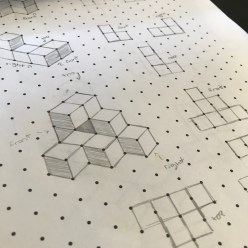 This time around, everyone seems to be doing much better. The lines are straighter and it’s beginning to look more like the 3D models. At first our lines were going in different directions and made it difficult to see the models, but after some practicing, it looks great! They’re also having an easier time seeing the front, right side, and top views from the isometric drawings. I like that they’re collaborating together and checking each other’s work.


 Learning with Ms. Medrano
You must be logged in to post a comment.